
Blog

Do you know what you want?
It’s not hard to want things. It’s one of the most basic expectations of modern society: we crave more stuff. A nice car. A bigger house. A better-paying job. From the time we’re children, our desires are put on display whenever we’re asked, “What do you want for Christmas?” We are taught to want more.
Recently, my wife and I went out on a date. After dinner, we went to a bookstore, which we do pretty frequently. We both love to read, and a bookstore is a cozy environment to spend time together, talk, and compare interests.
While there, we were in the children’s section and found a couple of books we thought our daughters would like. I bought two of them, and when we picked the girls up from my parents’ house, I offered our older daughter, who is three years old, the opportunity to pick which of the two books she wanted.
She wasn’t able to make an immediate choice, so we let her hold both books and look at them on the drive home to decide which one would be hers.
Her little mind was working overtime.
During the drive, she commented on the characters on the covers and the colors of the books. She flipped through the pages of both, and it still took her until we got home to finally make a decision.
I was the same way as a kid.
My aunts have told me many times that they would take me to the toy store, and I would find several toys I liked. They would tell me to pick one so we could go home, and I would agonize over the decision for so long that they would finally tell me, “Fine, you can get both. Let’s just go!”
Other times, it was easy for me to know exactly what I wanted.
Especially as I got older, I would fixate on one or two specific things—a toy, video game, book, or item of clothing—when I knew I was about to get some money for a birthday or, later, from a paycheck.
I understood money better, so I narrowed down the broad scope of things I wanted to focus specifically on those things I wanted most—or that mattered most—so that what I wanted was reasonable for the amount of money I had.
Sometimes, we want things that are reasonable. Unfortunately, even reasonable things can be unattainable at times, and we have to live without something that should be readily available.
Other times, our desires are unreasonable, but we can’t help wanting what we want.
A Bold Request
In Luke 18, Jesus was journeying toward Jerusalem. This was the final stage of His ministry before His arrest, trial, and crucifixion. On the way to that fateful city, He made several stops. One of the most notable was near the city of Jericho.
We know Jericho from the story of Joshua, when God told him to march his people around the city for six days and seven times on the seventh day. When they did, the walls collapsed, and Joshua and his people took the city.
Jericho remained a fixture in that region, and by Jesus’ day, it was a rich and fruitful territory. It’s said that the city was also home to thousands of priests and Levites. Economically and religiously, it was an important city.
So when Jesus approached, it’s no surprise there was a crowd around Him. It’s also possible that the road was crowded anyway, as many others would have been traveling toward Jerusalem for the Passover.
The events of Jesus’ visit to Jericho may have taken place chronologically shortly after His resurrection of Lazarus. His fame would have been greater than ever if that was the case, as He had publicly raised a man from the dead. With His notoriety so widespread, it’s no surprise that a crowd would gather around Him.
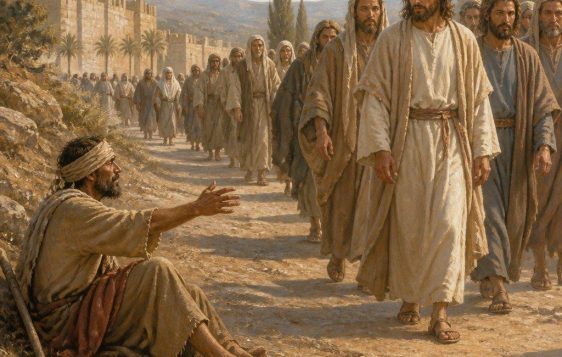
Near the city, a blind man was begging at the roadside. The parallel passage in Matthew 20 indicates there were actually two blind men. It may be that Luke chose to focus specifically on one of them.
The man wanted to know what the commotion was about, and the crowd told him that Jesus of Nazareth was passing by.
Clearly, the man had heard the stories.
As soon as he realized Jesus was close by, he cried out, **“Jesus, Son of David, have mercy on me!”**
Calling Jesus “Son of David” was an acknowledgment of His divine purpose. To use that title implied a direct connection to Messianic prophecy.
When the blind man called Jesus the Son of David, he was expressing confidence that Jesus was not just a rabbi or a physician. He was the God-appointed Savior the Jewish people had been waiting for.
The people around him tried to quiet him. They saw him as a nuisance, a distraction that would hinder Jesus’ journey. But despite their protests, the man continued to call out to Jesus, asking for mercy.
In this case, mercy can be understood as compassion. He was asking not for a stay of punishment but for relief from his circumstances. He wanted Jesus to look on him with compassion and act.
Jesus stopped and told those nearby to bring the blind man to Him.
When they were face-to-face, Jesus asked, **“What do you want me to do for you?”**
The man had already asked for mercy. Now, Jesus wanted to get specific.
What, specifically, did the man want?
Mercy and compassion are important. It is vital to the well-being and order of humanity that we are merciful and compassionate toward each other. But those feelings must overflow into action.
Jesus had compassion for the blind man. Now He invited the man to express what he wanted Him to do.
The blind man was a beggar. He sat by the roadside, dependent on the generosity of others. His blindness likely limited his opportunities to earn a living. We aren’t told whether he had family who could help him, but we know he was asking others for assistance.
He could have asked Jesus for money or food. He could have asked for help meeting his immediate needs.
**But he wanted more.**
Food, water, and money would be what we consider “reasonable” requests. They’re within the power of almost any person to provide.
But the man knew Jesus’ reputation, and he didn’t want what anyone else could offer.
He wanted more.
He wanted something only Jesus could offer.
**He asked Jesus for his sight to be restored.**
That’s a bold request.
But perhaps, for someone with a reputation for healing lepers and raising dead men to life, it didn’t seem impossible.
The blind man had bold confidence.
He had faith.
And that faith was rewarded.
Jesus said, **“Recover your sight; your faith has made you well.”**
To anyone else, the blind man’s request might have seemed impossible. It was too big an ask. Something nobody else could have accomplished.
But he was confident, without hesitation, that Jesus could deliver.
That faith was exactly what Jesus wanted to see. It’s what He wants to see in us, too.
What Do You Want?
Sometimes our desires can be corrupted by human nature. There are things we want for selfish reasons.
James 4:3 reveals that if we ask God for something with the wrong motives, we do not receive it because all we’re seeking is our own pleasure.
But there can be things we want that are not wrong for us to have.
Jeremiah 17:9 tells us that the heart is deceitful and not trustworthy, so we may be hesitant to trust the desires of our hearts.
But if our faith is in Jesus and the testimony of our lives is one of consistently walking with Him, our desires should increasingly align with what honors Him.
And so, as we examine ourselves, we should not be afraid, as children of God, to come to Him with genuine requests.
Just like the blind man, we can approach Jesus with our genuine requests, ask for His compassion, and trust Him with the outcome.
After all, He is the One who asked:
“What do you want me to do for you?”
Copyright © 2026 Lifeword.org. All rights reserved. No part of this article may be reproduced or reprinted without permission in writing from Lifeword.org
- Addiction (44)
- Bible Devotionals (413)
- Blog (3201)
- Christian Living (1395)
- Church Life (171)
- Culture (332)
- Devotionals (411)
- Discipleship (354)
- Evangelism (255)
- Lifeword Info (3)
- Marriage and Family (219)
- Ministry (201)
- Problems of Life (687)
- Questions About Christianity (3)
- Salvation (278)
- Spiritual Growth (650)
- Spiritual Questions (2)