
Blog

Pretty much anyone who grew up in church knows the children’s song about Zacchaeus.
He was a wee little man who climbed up in a sycamore tree to see Jesus. It’s probably as well-known among Christian children in America as common secular nursery rhymes like “Mary Had a Little Lamb” or “Old MacDonald.” Interestingly, the song’s authorship and date of composition are uncertain.
Because of that song, the story of Zacchaeus is one of the most familiar in the New Testament. His name is recognized throughout Christianity and has become synonymous with the change Jesus can make in the life of a sinner.
The story, recorded in Luke 19:1–10, begins with Jesus entering Jericho. He was on His way to Jerusalem, where many Jewish pilgrims would travel in preparation for the Passover celebration. What those around Jesus did not fully understand was that this journey would also lead to His arrest, crucifixion, and resurrection.
Before Jesus entered Jericho, He healed a blind man begging along the roadside, as recorded at the end of Luke 18. But that blind man was not the only person in the area who would receive compassion from Jesus.
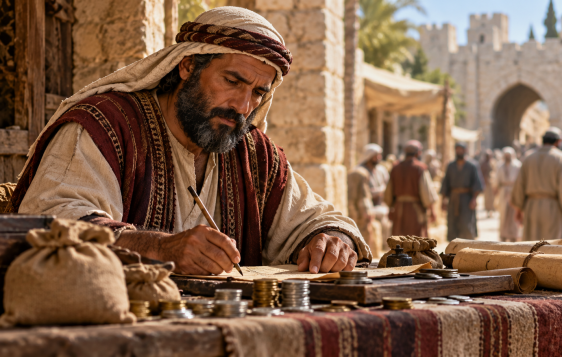
As word spread that Jesus was passing through the city, a man named Zacchaeus heard about it. Zacchaeus was a chief tax collector, and he had become wealthy through his profession.
Tax collectors were generally despised by the Jewish people because they were seen as sellouts. Many had earned their reputation by charging exorbitant fees beyond what was owed to the government and keeping the excess for themselves. This was how some became wealthy. Because of their association with the Roman government and their reputation for dishonesty, tax collectors were often social outcasts.
Despite this, Zacchaeus was willing to venture into a crowded public space to see Jesus.
When I imagine the scene that played out on the streets of Jericho, I picture a parade. Hundreds of onlookers gather along sidewalks lining either side of the street as massive floats roll by, decorated to draw the eye and delight the viewer. At Christmastime, people riding on the floats often toss handfuls of candy toward the crowd. Children push through the masses to scoop up as much as they can before running back to their parents.
Jesus wasn’t throwing candy, but He had drawn a crowd anyway.
In addition to the residents of Jericho who had come out to see Jesus, He was surrounded by fellow travelers making their way to Jerusalem. With the streets so crowded, it would have been difficult for someone arriving late to see what was happening.
When I was a preteen, my family visited relatives in Arizona for Christmas. My uncle took us to a parade near his girlfriend’s house, where one of the participants was a then-famous children’s television star. The most exciting part of the parade was when that actor’s car rolled by. Everyone shouted and cheered as he grinned and waved at us.
The residents of Jericho may have viewed Jesus in much the same way: a celebrity of sorts, a teacher and healer who had become famous throughout the region.
And Zacchaeus wanted to see Him.
The passage doesn’t tell us why Zacchaeus wanted to see Jesus. Perhaps he felt guilty about his profession. Perhaps he had heard Jesus’ message, and it resonated with him. Perhaps he was merely curious. Or perhaps he was searching for validation and love, since much of his community would have rejected him because of his work.
Regardless of his motivation, Zacchaeus was determined to see Jesus.
There was only one problem. The passage records that he was “short in stature” (v. 3).
I recently came across an interesting word study suggesting that the Greek wording leaves some ambiguity about whether this description refers to Zacchaeus or Jesus. While the traditional and more natural reading identifies Zacchaeus as the shorter man, the discussion raises an interesting question.
Ultimately, what matters to the story is that there was an obstacle preventing Zacchaeus from seeing Jesus.
And Zacchaeus wasn’t willing to let that stop him.
He climbed a sycamore tree along the route Jesus was taking. When Jesus reached the place where Zacchaeus was perched, He stopped, looked up into the tree, and called Zacchaeus by name.
Jesus told him that He was going to stay at his house.
Zacchaeus hurried down from the tree and gladly welcomed Him.
But the crowd wasn’t happy.
They grumbled about Jesus’ decision to stay with Zacchaeus, pointing to his reputation as a tax collector and calling him a sinner.
In response to their accusations, Zacchaeus stood and told Jesus:
“Behold, Lord, half of my goods I give to the poor. And if I have defrauded anyone of anything, I restore it fourfold.” (Luke 19:8)
It’s possible that this was an acknowledgment of guilt. Perhaps Zacchaeus was admitting that he had, in fact, cheated people. His statement, “if I have defrauded anyone,” leaves room for that possibility.
Interestingly, the Greek verbs translated “give” and “restore” are in the present tense. Some interpreters understand this to mean Zacchaeus was describing actions he had already begun taking. Others understand his words as a declaration of what he was committing to do in response to his encounter with Jesus.
Either way, his words revealed something significant.
The crowd saw a guilty man, condemned by his profession.
Zacchaeus was an outcast, rejected because he had chosen a career that separated him from his countrymen. It’s possible that he had once used his position for personal gain. But his response revealed a heart that valued something more than money.
He was willing to put action behind his words.
Whether Zacchaeus had already begun making restitution or was committing to do so at that moment, he was demonstrating a change of heart through a change of action.
And there, in front of the crowd, Zacchaeus gave evidence that his wealth was no longer what mattered most.
Jesus responded:
“Today salvation has come to this house, because he, too, is a son of Abraham. For the Son of Man came to seek out and to save the lost.” (Luke 19:9–10)
When the crowd labeled Zacchaeus a sinner, Jesus called him a “son of Abraham.”
His occupation did not place him beyond the reach of salvation. Jesus saw beyond the label the crowd had placed on him.
Unlike the rich ruler in Luke 18:18–30, Zacchaeus did not cling to his wealth. He was willing to give generously to the poor and repay those he had wronged fourfold. His response demonstrated that he recognized the value of Jesus over the value of earthly possessions.
Luke 18 tells us that it is easier for a camel to go through the eye of a needle than for a rich man to enter the kingdom of God.
And in Luke 19, we see salvation come to the house of a rich man.
What seemed impossible to man was possible with God.
Zacchaeus’ wealth couldn’t save him. His profession couldn’t disqualify him. And the crowd’s opinion couldn’t prevent Jesus from calling him.
Because Jesus had come to seek and save the lost.
We go through life branded with all kinds of labels.
People put one another in boxes. There are the kinds of people we’re comfortable with and those we aren’t. Those we welcome and those we look down our noses at.
And while we’re busy boxing in others, they’re doing the same thing to us.
What labels have you been living with?
Have you been branded unlovely? Unworthy of someone’s time? Have others decided who you are because of something you’ve done in the past?
Your past doesn’t put you beyond the reach of God’s grace.
Jesus sees you as someone He died for. Someone He loves. Someone He came to seek and save.
Have you responded to His compassionate invitation in faith?
Copyright © 2026 Lifeword.org. All rights reserved. No part of this article may be reproduced or reprinted without permission in writing from Lifeword.org
- Addiction (44)
- Bible Devotionals (413)
- Blog (3206)
- Christian Living (1395)
- Church Life (171)
- Culture (332)
- Devotionals (411)
- Discipleship (354)
- Evangelism (255)
- Lifeword Info (3)
- Marriage and Family (219)
- Ministry (201)
- Problems of Life (687)
- Questions About Christianity (3)
- Salvation (278)
- Spiritual Growth (650)
- Spiritual Questions (2)