
Blog

Among the many things you have to teach children to turn them into respectful, functional adults, gratitude is a quality that is often forgotten.
It’s easy to miss. We all take thankfulness as something we do almost unconsciously. We say “thank you” when someone does something for us, whether it’s holding the door as we walk into a restaurant or giving us an expensive gift for a birthday or anniversary. But those “thank yous” often become so automatic that we forget their importance. You can tell when a person has been trained to be grateful because their “thank you” comes almost unconsciously, as an off-the-cuff response.
It’s more noticeable when people do not say “thank you.” When we do something for someone and they don’t respond with gratitude, it can be jarring. We’ve come to expect people to respond with the appropriate politeness. When they don’t, we feel slighted. And when we’ve made an effort to do something for them, that feeling makes sense.
I think mothers may be among the most unthanked demographics of people. How many things do our mothers do for us that we don’t even consciously recognize? I know that growing up, I was never surprised when I went to my dresser and opened the drawers to find them full of folded clothes, even though I wasn’t the one doing the laundry. I wasn’t surprised to go to the refrigerator or the cupboards and find them stocked with the food I loved, even though I wasn’t the one going shopping.
Who does all those things? In many households, it’s the mother. And how often do we say “thank you” for those things?
Not nearly enough.
In Luke 17:11–19, Jesus was traveling to Jerusalem. The route He was taking—between Samaria and Galilee—was not the most straightforward path, but there are several reasons He might have taken this route when considering events in the other Gospel accounts that don’t appear in Luke. Regardless of His reasoning, Jesus went through this region with intention.
As He did, He encountered ten lepers in a village.
These lepers were likely congregated together because they were some of the only companionship one another had. According to Old Testament law, those suffering from certain serious skin diseases were considered ceremonially unclean and required to live outside the community. They could not simply return to normal life, and to be readmitted into society, they had to present themselves to a priest who could confirm that they were clean.
As Jesus passed, the lepers called out to Him from a distance. If He had been preaching in the surrounding villages, then it is no surprise that news of His miracles had reached these men.
Desperate for healing, they begged Him for mercy.
Jesus instructed them to go show themselves to the priests.
They obeyed immediately.
As they walked, they suddenly became healthy. They had been cured of their leprosy.
They were so excited that they proceeded toward the priests. One, however, stopped.
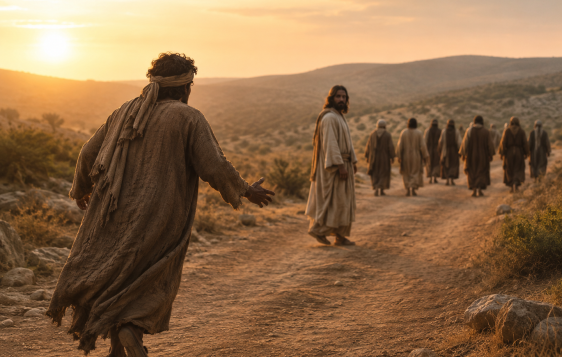
He recognized the miracle that had been done and quickly turned back to return to Jesus. He praised God loudly as he went, and when he reached Jesus, he dropped to the ground in worship and began thanking Him.
This one man, out of the ten, was a Samaritan.
If you remember the other conversations we’ve had about Samaritans, they did not get along with the Jewish people. They were subject to significant cultural and religious hostility. And I’m sure they, in return, were no fans of the Jews.
But this man unashamedly and unapologetically flattened himself on the ground to thank Jesus for His mercy.
And when Jesus saw this, He wondered, “Didn’t I heal ten men? And only one of them, a foreigner, has returned to show gratitude and praise God?”
It was a good question.
Jesus had healed all ten of them. Why did only one—the one most likely to distrust Him because of cultural and religious differences—come back to say thank you?
In response to the man’s gratitude, Jesus said, “Go your way. Your faith has made you well.”
Does that mean that the other nine men became leprous again?
No. The healing was done; Jesus would not undo it. The phrase “made you well” can also carry the sense of being “saved.” This man was grateful to Jesus because he recognized something the others did not: Jesus was not just a physical healer, but a spiritual one as well.
The man had faith in Jesus not just for his temporary condition, but as Savior and Lord. And this led to the more important healing: the restoration of his soul in communion with God.
God does many things for us—things we often don’t notice or pay much attention to. He is constantly at work in our lives, in ways both big and small.
Are we grateful for them?
My family has seen God’s blessings most obviously and consistently in our ongoing car troubles. In the past five years, we’ve gone through four separate cars due to catastrophic breakdowns or car accidents.
Yet God has always provided.
Most recently, after a car accident left us without transportation right before we were supposed to lead Vacation Bible School, God provided through a family in the church who told us we could use their spare car for that week. This family was new to our congregation, so their offer was unexpected but incredibly well-timed.
The blessings continued. On the last day of VBS, we were able to sign the papers, close a deal, and pick up a new car of our own.
God saw us through by providing temporary transportation and, when that ran out, a new vehicle for us.
We certainly praised Him for that.
But how many other works does He do that we forget to thank Him for?
This Samaritan was thankful. Jesus commended him for it and acknowledged that it came from a place of faith.
Are we grateful?
And where does our gratitude come from?
Is it a habitual platitude to say “thank you,” or does it come from a genuine heart that faithfully praises God for His goodness to us?
Copyright © 2026 Lifeword.org. All rights reserved. No part of this article may be reproduced or reprinted without permission in writing from Lifeword.org
- Addiction (44)
- Bible Devotionals (413)
- Blog (3198)
- Christian Living (1395)
- Church Life (171)
- Culture (332)
- Devotionals (411)
- Discipleship (354)
- Evangelism (255)
- Lifeword Info (3)
- Marriage and Family (219)
- Ministry (201)
- Problems of Life (687)
- Questions About Christianity (3)
- Salvation (278)
- Spiritual Growth (650)
- Spiritual Questions (2)