
Blog

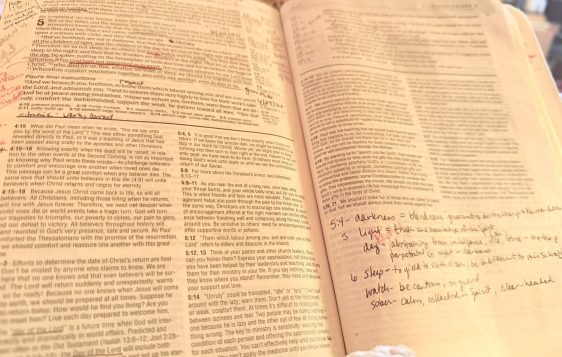
My friend Jon can tell you that this is certainly true of me.
You can tell me something, and even if I believe you, I still need to see it. I need to see how you came to that conclusion. I need to walk through the process myself to truly understand it. And sometimes, that means creating some type of visual, like a chart or diagram, to bring me to the conclusion he’s already arrived at.
As we created FOLLOW, our online discipleship portal through Lifeword, this was a daily occurrence. Jon is a tech guy, so he just flies right through it. And then he sees that look on my face, and he knows what’s coming.
“OK, but what does that look like? Give me an example. And how would that work? Let’s walk through it so I can see it and understand it. I believe you, but I need to see it for myself.”
As followers of Christ, our approach to Scripture and teaching should be similar.
1 Thessalonians 5:20–21
“Do not despise prophecies. Test all things; hold fast what is good.”
Paul gave some final instructions in his letter to the believers in Thessalonica.
Rejoice. Always pray. Be thankful in all things. Obey the Holy Spirit.
And now, he says, don’t despise what is spoken, but test it. Examine it. Take what you hear and determine whether it is true.
Go to the Word and study it. Examine what you hear from teachers and preachers and compare it to the Bible.
I don’t want to just tell you something; I want to show you how we arrived at that conclusion. When someone asks you why you believe something, which is better?
“That’s what I’ve always been told.”
Or:
“I searched it out in the Scriptures, and here’s where it says that.”
Everyone has a platform today. And unfortunately, everyone has an agenda. With so many voices speaking into your life, be wise. Take what you hear to the Word of God and compare it.
And if you aren’t sure how to do that, let me show you.
START WITH WHAT WAS SAID
What exactly is the claim being made?
Before you agree with it—or disagree with it—make sure you understand what is actually being said. Write it down if you need to. Strip away the emotion, the personality of the speaker, and how convincing it sounded.
What are they actually claiming the Bible says?
GO TO THE SCRIPTURE
Now find the passage being used.
Don’t just read the verse someone quoted. Read what comes before it and what comes after it. Who is speaking? Who are they speaking to? What is happening in the passage?
A verse pulled out of context can be made to sound like it says something it never intended to say.
COMPARE SCRIPTURE WITH SCRIPTURE
Don’t build an entire belief on one isolated verse.
What does the rest of the Bible say about this subject? Scripture does not contradict Scripture. The more you know God’s Word, the easier it becomes to recognize when something doesn’t line up.
ASK QUESTIONS
It’s OK to ask questions.
Where does the Bible say that?
Is that what this passage actually means?
Am I reading my own opinion into the text?
Is there another passage that helps me understand this one?
Questions aren’t the enemy of faith. They can drive us deeper into the Word.
HOLD FAST TO WHAT IS GOOD
That’s where Paul takes us.
Test all things—and then hold tightly to what is good.
The goal isn’t to become suspicious of every preacher, teacher, Bible study leader, podcast host, or Christian friend. The goal is to become so grounded in the Word of God that you recognize truth when you hear it.
You don’t have to believe something simply because someone with a platform said it.
Open your Bible.
Read it.
Study it.
Test what you hear against it.
And when you discover that what you’ve been taught lines up with the truth of God’s Word, you can say something much stronger than, “That’s what I’ve always been told.”
You can say, “I’ve seen it for myself.”
Copyright © 2026 Lifeword.org. All rights reserved. No part of this article may be reproduced or reprinted without permission in writing from Lifeword.org
- Addiction (44)
- Bible Devotionals (413)
- Blog (3200)
- Christian Living (1395)
- Church Life (171)
- Culture (332)
- Devotionals (411)
- Discipleship (354)
- Evangelism (255)
- Lifeword Info (3)
- Marriage and Family (219)
- Ministry (201)
- Problems of Life (687)
- Questions About Christianity (3)
- Salvation (278)
- Spiritual Growth (650)
- Spiritual Questions (2)