
Blog

Have you ever had to wait for something?
As children, we anticipate coming events—such as birthdays and holidays—with great excitement. We get jittery, anxious, and maybe a little over-energized. The days roll by all too slowly as we look toward a long-awaited moment. It reminds me of one of my daughter’s storybooks, Llama Llama Holiday Drama by Anna Dewdney. In the book, the titular character eagerly anticipates the coming holiday—making crafts at school, buying presents for friends, setting up the tree, baking cookies—but the day takes too long to arrive. At last, he has a “holidrama” meltdown and needs to be comforted by Mama Llama, who reminds him that the holidays are about slowing down and spending time with family.
When I was seventeen, my family—not just my parents, but grandparents, aunts, uncles, and cousins on my dad’s side—went on a cruise to Alaska to celebrate my grandparents’ fiftieth wedding anniversary. The trip was scheduled for August, and that whole summer the family was giddy with anticipation. We lived half a country apart, with my parents, siblings, and me in Kansas and my extended family in Arizona, but we texted daily about our excitement. I would create a countdown graphic each afternoon, ticking off the days until we could finally board an airplane to Seattle, where we would step onto the cruise ship.
There was something the Jewish people were waiting for with even greater anticipation: the coming of the Messiah and the establishment of His kingdom. They had been enslaved by Babylon, oppressed by the Medo-Persian and Greek Empires, won a brief century of independence, and then returned to subjugation under Rome. They were weary of being the underdog. They expected their Messiah to appear, raise a sword, overthrow Rome, and establish a powerful kingdom that would never end.
Then Jesus came on the scene. While not everyone believed He was the Messiah, His disciples did. Those who followed Him were convinced; Peter declared as much in Luke 9:20. Yet even though they recognized His identity, there was still confusion about His mission. They were still waiting for a coming kingdom—one Jesus promised they would see.
At the end of that conversation (Luke 9:27), Jesus told them that some standing there would not taste death until they had seen the kingdom of God (or, as Matthew records, “the Son of Man coming in His kingdom”). This statement can confuse modern readers because we often picture God’s kingdom as a future event. However, Luke 9:28–36 reveals that Jesus was referring to what would soon occur. He did not mean the disciples would live thousands of years to witness the Millennial Reign. Nor did He mean He was about to overthrow Rome. They anticipated one thing, but Jesus intended to show them something entirely different.
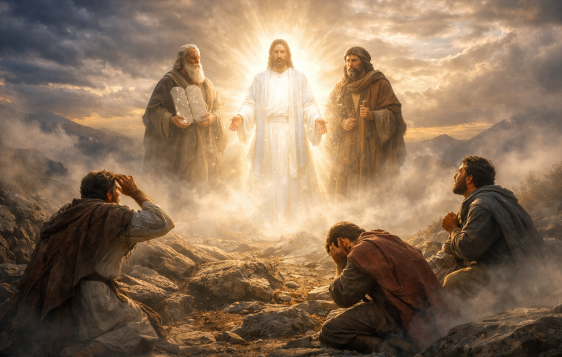
Jesus took Peter, James, and John—His inner circle—up a mountain. Luke tells us this happened “about eight days” later, emphasizing that this event was directly connected to Jesus’ earlier statement. When Jesus reached the top, He began to pray, and as He prayed, His appearance changed. His clothing became dazzling white, and His face was altered. Then two men appeared—men the disciples somehow recognized as Moses and Elijah. However this recognition occurred, the significance is clear. Moses represented the Law; Elijah represented the Prophets. Two pillars of Jewish Scripture stood beside Jesus.
They spoke with Him about His “departure,” which He was about to accomplish in Jerusalem. Peter, James, and John had been sleeping (as was often the case with them). Imagine waking to see your teacher glowing with radiant light, standing beside two recognizable heroes of the faith. It is remarkable they did not faint again! Most importantly, Luke tells us they “saw His glory.” This was the fulfillment of Jesus’ promise that some would see the kingdom of God.
Eventually, Moses and Elijah faded from view. As they departed, Peter blurted out, “Master, it is good for us to be here. Let us make three tabernacles—one for You, one for Moses, and one for Elijah.” But Luke notes that Peter did not know what he was saying.
(He often didn’t.)
The issue with Peter’s suggestion is that a tabernacle is a place of worship. In his excitement, Peter unintentionally placed Moses and Elijah on equal footing with Jesus. How quickly he—who had just proclaimed Jesus as the Messiah eight days earlier—lost perspective in the presence of something spectacular.
Then a cloud enveloped them, and the disciples were terrified. A voice from the cloud declared that Jesus was His Son, His Chosen One, and commanded them to listen to Him. God said nothing about listening to Moses or Elijah. They were servants. Jesus was the Son. He alone possessed full authority.
When the cloud lifted, Jesus stood alone. The disciples told no one what they had seen.
What do we learn from this?
First, Jesus’ words proved true. His prophecies were—and are—reliable. We can trust Him.
Second, we must guard against Peter’s mistake. There are many good things in this world—blessings, opportunities, relationships, achievements. None of these are inherently wrong. Yet in a moment, a good gift can become a god. Peter was so overwhelmed by the glory of the moment that he misplaced his worship. We can do the same. Something beautiful, meaningful, or exciting can quietly take God’s rightful place in our hearts. We must never allow a good thing to ascend to godhood in our lives.
Third, this event unmistakably affirmed that Jesus is the Messiah. Peter confessed it. The Father confirmed it. Jesus did not claim to be merely a teacher, philosopher, or moral example. He is the Son of God. And the command given on that mountain still applies to us: listen to Him.
Are we putting Him first? Are we listening? Are we following?
Copyright © 2025 Lifeword.org. All rights reserved. No part of this article may be reproduced or reprinted without permission in writing from Lifeword.org