
Blog

Have you ever failed to make the cut for something?
Writing has always been a dream of mine—specifically, becoming a successful author of fiction books. That dream began when I was nine years old, but it wasn’t until college that I started taking it seriously and working on stories of my own. When I completed my first manuscript, I pitched it to many editors, agents, and publishers. Some liked the idea but chose not to publish it, either because their calendars were full or because it wasn’t what they were looking for. Others never responded at all. While I have since been published, it took several rejections—and sending out a different book idea—to finally get there.
I have applied to multiple jobs, both as a teenager preparing to graduate high school and later as a post-college adult, and I was rejected from many of them. Some involved interviews that I thought went really well, but they still ended in rejection. Sometimes, there is simply a better candidate.
If you have ever tried out for something—whether a job, a sports team, or a performance—you have probably experienced rejection. If you haven’t, you likely will at some point in your life. That’s how the world works. Rejection happens because decisions are made based on what is best for the person making the choice. If you are not the right fit for their team, production, or staff, you won’t make the cut.
This idea of “making the cut” has long been part of an ongoing and often contentious conversation about the role of women in the church. Do women make the cut for service in ministry? Historically, the modern church—most likely beginning with the rise of Catholicism, but perhaps even earlier—has often placed heavy limitations on the role of women. Some churches allow women to serve in any and all capacities, including pastoral and diaconal roles, citing examples such as Priscilla (Acts 18:26), Phoebe (Romans 16:1–2), and Junia (Romans 16:7). Others hold a more traditional view, believing women cannot serve as pastors (based primarily on 1 Timothy 2:11–15) but may otherwise serve in many meaningful ways. Still, some churches restrict women from nearly all visible or substantive roles, particularly during worship services, based on strict interpretations of passages such as 1 Corinthians 14:34–35 or 1 Timothy 2:11.
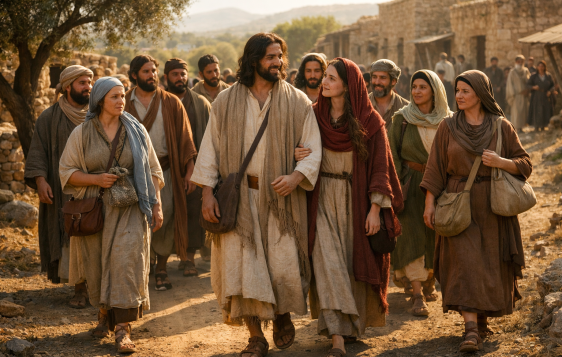
When we turn to Luke 8:1–3, we see how Jesus included women—alongside His other disciples—in His ministry.
“Soon afterward he went on through one town and village after another, proclaiming and bringing the good news of the kingdom of God. The twelve were with him, as well as some women who had been cured of evil spirits and infirmities: Mary, called Magdalene, from whom seven demons had gone out, and Joanna, the wife of Herod’s steward Chuza, and Susanna, and many others, who ministered to them out of their own resources” (Luke 8:1–3, NRSVUE).
This short passage serves primarily to set the stage for the rest of the chapter, but it contains important insight. Luke frequently emphasizes women, Gentiles, and other outsiders more than the other Gospel writers, and this is a clear example of that emphasis. Here, Luke records the identities and contributions of women who followed Jesus—something the other Gospels do not do in the same way.
This passage follows immediately after the account of a woman anointing Jesus’ feet and receiving forgiveness for her sins. After leaving the home of Simon the Pharisee, Jesus continued traveling throughout the surrounding region. At this stage of His ministry, His primary focus was proclaiming the kingdom of God. While Jesus performed many miracles, those miracles served to affirm His message. Though He deeply cared for physical healing, He understood that spiritual healing was humanity’s greatest need, which is why the Gospel remained His priority.
As Jesus traveled, His disciples went with Him. Luke specifically notes that the twelve were present, which is no surprise. However, Luke also makes it clear that they were not the only ones following Jesus. There were women traveling with Him as well—women who had been healed of evil spirits or illnesses and chose to follow Jesus rather than return to their former lives. This was significant because most rabbis of that era did not allow women to be disciples. Instead of limiting them, Jesus welcomed them into His ministry.
The first woman mentioned is Mary Magdalene, best known as the first person to whom Jesus appeared after His resurrection. This passage shows that Mary followed Jesus long before the crucifixion. Later church tradition claimed that Mary Magdalene had been a prostitute, but there is no biblical evidence to support this idea. Scripture only tells us that she had been possessed by seven demons and that Jesus delivered her. The association with prostitution appears to have developed much later, possibly to diminish her influence or importance. Regardless, Mary Magdalene was a woman healed by Jesus who followed Him faithfully with gratitude and devotion.
Next, Luke mentions Joanna, the wife of Chuza, Herod’s household manager. This connection suggests that she lived among wealth and political power and may have even been Roman. If she was Jewish, her association with Herod—who was widely disliked among the Jewish people—likely placed her outside traditional religious circles. Still, she chose to follow Jesus, demonstrating remarkable faith. It is even possible that Joanna’s influence helped Luke gain detailed insight into Herod’s life and actions.
The third woman, Susanna, is mentioned only here. We know nothing else about her, though her inclusion may indicate that she was known personally to Luke. Luke then adds that there were many other women who followed Jesus as well. Their primary role, he explains, was to provide financial support for the ministry. These women used their own resources to sustain Jesus and the disciples as they traveled and preached. Without their support, the disciples would have had to continue working in their former trades, leaving far less time for ministry. These women were not secondary contributors—they were essential to the advancement of the Gospel.
Luke also emphasizes that these women were with Jesus. While there may have been times when they remained behind in places like Capernaum to manage business affairs, there were also times when they traveled alongside Him. They were active participants in the ministry, not lesser contributors.
This leads us to an important truth: Jesus does not exclude those who genuinely follow Him. He welcomes anyone who believes with a sincere heart—man or woman, rich or poor, Jew or Gentile. In God’s eyes, there is no hierarchy of worth. As Paul later wrote, “There is no longer Jew or Greek… male and female; for all of you are one in Christ Jesus” (Galatians 3:28). No matter your background or past, if you desire to serve God, He will not turn you away. He will use you for His purposes—just as He used a woman once possessed by seven demons, who became one of His most devoted followers. Your past does not define you. Your willingness to follow does.
Copyright © 2025 Lifeword.org. All rights reserved. No part of this article may be reproduced or reprinted without permission in writing from Lifeword.org