
Blog

It takes dedication to be part of something bigger than yourself. Anyone who is part of a sports team, choir, or club must be dedicated and willing to make sacrifices. You don’t make the cut if you aren’t willing to give up something else. Look at a high school or college football team: if a player slacks off, never shows up to practice, and doesn’t give it his best effort, he’s going to be sitting on the bench—at best. Even more likely, it won’t be long before he’s off the team. You only get in the game by putting in hard work, proving yourself to be a team player, and dedicating yourself to becoming skilled at the game.
The same goes for a choir or a band. If you never participate in rehearsals or listen to your director, you probably won’t remain in that choir or band for long. If you would rather go to a coffee shop, scroll on social media, or hang out with your friends, you probably won’t excel at a group activity like a sports team or choir. You must give up something to achieve something.
And that doesn’t just apply to group activities. It takes discipline to accomplish many things in life. As a writer, if I want to write a book, it requires several things. It takes time. I have to sit down and choose to dedicate time to writing instead of playing video games, scrolling social media, reading, or spending time with my family. That’s a sacrifice. It takes effort and mental energy. Some days it’s easier to write than others, but even on those days it requires thought and imagination, and that can be draining. It also takes communication. I must communicate with publishers to get my book into the world and connect with audiences so they know it’s available.
Everything worth doing requires effort and sacrifice. Yet for some reason, many people think that following Jesus works differently. Just as you wouldn’t give the bare minimum on the football field or in the band hall, you shouldn’t assume it’s acceptable to give the bare minimum when it comes to being a Christian. Many believers, particularly in America, are content to come to church, sit and listen—or pretend to listen—to the sermon, mumble through a song, and go home acting as if they’ve made a great sacrifice for Jesus. No—this is the bare minimum! Many people will expect a thumbs-up and a “Good job” from Jesus when they get to heaven, only to be shocked when they realize they haven’t truly lived for Him. What does coming to church really cost? A Sunday morning of sleeping in. A Wednesday night that might otherwise be spent on the couch. These are not the sacrifices Jesus described when He called us to follow Him. Luke 9:18–26 reveals the cost Jesus expects from us.
He asked His disciples, “Who do people say I am?” This question connects to earlier verses in Luke 9, where Herod heard about Jesus and speculated about His identity. The disciples’ answers matched Herod’s conclusions: that Jesus was John the Baptist resurrected, Elijah, or another prophet returned from the dead. Interestingly, all these theories looked backward. The people could not imagine that Jesus was someone entirely new. They could only interpret Him through the lens of the past.
Then Jesus asked, “Who do you say that I am?” He no longer wanted public opinion. He wanted the convictions of His closest followers. God does not move in reverse. He uses the past to teach us, but His work unfolds in the present and future. You don’t see God resurrecting Billy Graham to preach more sermons in America. Billy Graham had his time and used it well. Now it is time for others to continue the work.
Peter answered, “The Christ of God.” Christ means “Messiah,” the Savior the Jewish people had awaited for centuries. But Peter went further by saying Jesus was “of God.” In Matthew’s account (Matthew 16:13–20), he says, “the Christ, the Son of the Living God.” Peter recognized that Jesus was not merely a man—He was the embodiment of God’s power and holiness.
Jesus instructed them not to tell anyone—not because He wanted secrecy, but because His appointed time had not yet come. He warned them that He, the Son of Man, would suffer persecution, rejection, and death. Yet He ended with hope: on the third day, He would rise again.
Matthew’s and Mark’s accounts (Matthew 16:13–20; Mark 8:27–38) reveal that Peter responded by saying, “No, surely You won’t die!” Jesus rebuked him with the strong words, “Get behind Me, Satan.” The word “Satan” means “adversary.” In that moment, Peter unknowingly positioned himself against Jesus’ mission by trying to prevent the cross.
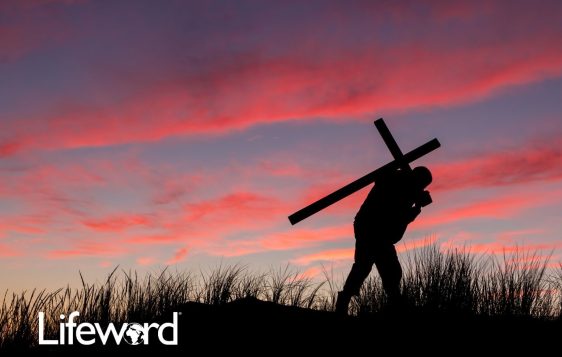
Finally, Jesus told them they must deny themselves. They must take up a cross—an instrument of humiliation, suffering, and death—and follow Him. Though He was not speaking of a literal cross at that moment, His message was clear: obedience requires sacrifice. They could spend their lives building wealth and reputation, but in eternity, those pursuits would offer no lasting gain.
The same is true for us. The bare minimum is not true discipleship. It is simply going through the motions while remaining comfortable. If church attendance is the only expression of obedience in our lives, it becomes little more than lip service. Where is the daily study of Scripture and prayer? Where is the generosity that puts others before ourselves? Where is the courage to speak for those who cannot speak for themselves? Where is the boldness to share the gospel so others may know His love? Where is the faith that sustains us in hardship instead of turning to the world’s substitutes—drugs, alcohol, or pornography? Genuine faith is not confined to a church service; it is lived out every day.
I have much growing to do, and perhaps you do as well. The question is this: Will we put in the effort? If we truly believe that Jesus is the Messiah and the Son of God, then we must also be willing to take up our crosses, follow Him wholeheartedly, and even lose our lives for His sake in order to truly find them.
Copyright © 2025 Lifeword.org. All rights reserved. No part of this article may be reproduced or reprinted without permission in writing from Lifeword.org