
Blog

As a parent, there is nothing my daughters could do to make me stop loving them. Even when I am frustrated with their behavior, my love for them does not change. I don’t determine their value by their actions—whether they obey or disobey—but by the simple truth that they are my children. I may experience greater joy when they treat me like a beloved parent instead of an irksome enforcer of rules, because relationship flows more easily that way. But regardless, they are my daughters. For that reason alone, they have my unchanging love.
The other day, my older daughter—two and a half years old—was wearing a green overall dress. I had been at Bible study, and when I got home, I noticed that one of the buttons on the overall straps had come off. I asked her what had happened. She stepped back, held up her hands, and firmly said, “No!” I looked at my wife, who explained that our daughter had pulled the button off and was now embarrassed about it, responding with “No!” anytime it was mentioned. She was ashamed of what she perceived as a wrong action and didn’t want attention drawn to her mistake.
A few days later, I found a large foam strawberry toy she had recently received, with a sizable chunk missing from the top. I asked her if she had bitten it or torn it apart. Again, she held out her hand and said, “No!” She wasn’t denying that she had done it—she was refusing to talk about it. Although my love for her is unchanging, she has reached an age where she recognizes when she has done something wrong and does not want her shame brought into the open. Perhaps she fears the consequences, or perhaps she worries it will change my love for her. Either way, she wants to avoid the shame that comes with falling short.
In Luke 8, we follow Jesus on a journey across the Sea of Galilee. After teaching a large crowd, He became exhausted and boarded the disciples’ boat. They sailed across the sea, through a storm, to the opposite shore, where He encountered a man possessed by a demon. Later, in Luke 8:40, Jesus returned to the side of the Sea of Galilee from which He had departed.
When the boat came ashore, the crowd was still waiting for Him. Jesus had become so well known that even after He sailed away, the people were confident He would return to Capernaum and chose to remain there. Many were eager to witness more miracles or were waiting for healing of their own.
Soon after Jesus arrived, a man named Jairus approached Him. As a synagogue ruler, Jairus was someone who would normally have opposed Jesus. Many religious leaders in Judea viewed Jesus as a heretic or a renegade preacher leading people away from the Law. The disciples may have expected confrontation, but instead Jairus fell at Jesus’ feet and begged Him for help. His only daughter, twelve years old, was dying.
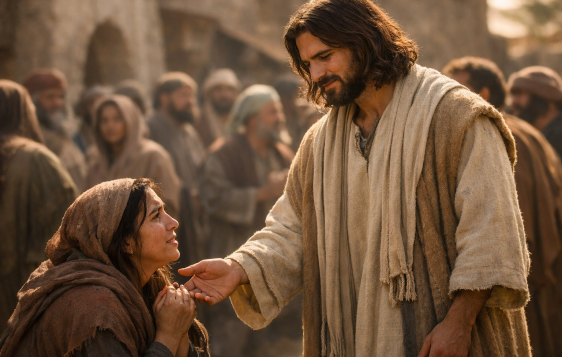
Jesus willingly went with Jairus, but as they moved through town, the crowd pressed in on Him. They followed closely, jostling and straining to get near. In the midst of this chaos, a woman approached. She had suffered from a blood disease for twelve years. Luke’s description—often translated as a “flow of blood” or “blood discharge”—suggests a constant condition, likely related to irregular menstrual bleeding. Such a condition rendered her ceremonially unclean in Jewish culture, making her untouchable and isolated.
She had seen many physicians and spent all she had, yet no cure came. She was lonely, in pain, and hopeless. Still, she believed that if she could only touch the hem of Jesus’ garment, she would be healed. The hem likely referred to the ceremonial tassels sewn into Jewish robes as reminders to obey God’s Law.
The moment she touched Him, her bleeding stopped, and Jesus felt power go out from Him. He stopped and asked who had touched Him. Peter was confused by the question, pointing out that the crowd was pressing in on Him from every side. But Jesus insisted that someone had touched Him intentionally. Trembling, the woman stepped forward and explained what had happened. Jesus told her that her faith had made her well.
Then He called her “daughter.”
This woman, isolated for twelve years, likely had no close relationships. She may have felt unlovable and forgotten. But Jesus affirmed her identity—not unclean, but daughter. A child of God. She was restored, healed, and no longer an outcast.
Jesus continued on to Jairus’ house, but before they arrived, messengers told Jairus that his daughter had died. Jesus told him not to fear, but to believe, and they continued. Inside the house, Jesus brought Peter, James, and John, along with the girl’s parents. Though mourners laughed when Jesus said the child was only sleeping, He ignored them. He took the girl by the hand and told her to rise. Immediately, she came back to life. Jesus instructed the parents not to tell anyone what had happened.
In this story, we see Jesus’ compassion for the outcast, the suffering, and the grieving. He was gentle and loving toward the woman with the blood discharge and brought comfort and restoration to Jairus and his family. Whatever trials we endure, God sees us and loves us. He calls us “Daughter” and “Son,” reminding us that our value is not found in perfection, but in belonging to Him. If you feel lonely, unloved, or broken, God still cares—and He welcomes you with open arms.
Copyright © 2025 Lifeword.org. All rights reserved. No part of this article may be reproduced or reprinted without permission in writing from Lifeword.org