
Blog

Death is not something we like to talk about.
When we consider death, it’s often with sadness, a somber heaviness, and fear. We don’t want to face death, and we don’t want to lose our loved ones to it. It is a horrifying subject to think about.
When we’re young, most people don’t have to dwell on dying. Youth comes with a feeling of invincibility. We think death is for old people, and we do reckless things and live our lives casually because we’re certain we still have our whole lives ahead of us. This usually continues even if we lose someone close to our age, because although it was sad it happened to them, we never consider that it could happen to us, too.
Death, unfortunately, does not discriminate by age. When I was a junior in college, I was on the Student Orientation Staff. We went through two days of training and preparation to welcome the new students. The night before we were scheduled to help the freshmen move into the dorms, we got word that one of our team members, a guy named Cody, had been killed in a motorcycle accident. All of us were shaken and couldn’t believe it. We had an early meeting the next morning, did what we could to fill the gap he had left, and tried to smile and be happy for the freshmen, who had no idea what had happened the night before.
I didn’t know Cody well, but I have two memories of him. The first is that we were on a ropes course during the training days. He and I were opposite each other, and we had to call each other’s names to ask “permission to belay,” saying each other’s names to make sure we were speaking to the right person. I was frantic because I couldn’t remember Cody’s name. I knew everyone else there, but I couldn’t think of his name. Thankfully, at the last second, it came to me. The second memory is that on the very morning of the day he died, I played foosball with him and some of our mutual friends.
However, I had the privilege of writing an article about his passing for the college newspaper. That allowed me to interview his friends and learn more about him. Although that was eight years ago, I still remember those personal details about Cody. His favorite movie was Frozen. His favorite color was pink. He was a sweet, genuine guy. He was on the baseball team. He came to understand during his first year at CBC that he did not yet truly know Christ, and his coach was able to lead him to saving faith, less than a year before Cody would die. Those facts are rooted in my brain because even though I didn’t know him, he was someone I could’ve been friends with if he hadn’t abruptly lost his life.
Of course, when we lose someone who we know is a believer, we can take comfort in knowing they’re in heaven. It’s still difficult to accept sometimes, because they can’t be with us here anymore, and we miss them. And that’s okay. The Bible never says not to grieve over a lost loved one. We can both grieve and feel comfort in knowing they are with God and that we will see them again one day. The two are not exclusive. We should not try to shut down the grieving process with platitudes that gloss over pain rather than heal it. Nor should we force those platitudes on others, because often they don’t provide the comfort we hope they do when we don’t know what else to say.
Luke 7:11–17 is about death. It is also one of the first passages in Luke that focuses on a woman. The Gospel of Luke highlights women more than the other gospel writers. This is one example of Jesus showing compassion to a woman whom many men in His day would not have acknowledged. This is an important facet of Luke, because it reminds us that while many nonbelievers say the Bible is sexist or hateful toward women, Jesus and His disciples frequently empowered women and gave them more weight and importance than any other culture did in those days.
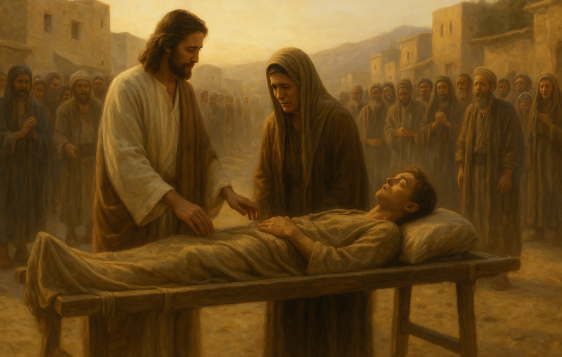
The passage opens with Jesus visiting a town called Nain. This was a small village southeast of Nazareth that wouldn’t make it onto most Bible maps. As He traveled through Nain, He came across a funeral procession. The man who had died was an only child and apparently fairly young—young enough that it was his mother, not a wife or children, who was the focus of the grieving. It’s mentioned that he was her only child, and that she was a widow. In those days, women could not be landowners. They lived with their husbands who owned the land, and if their husband died, they would move in with their oldest son on his property. With no husband and no son, this woman would have been, for all intents and purposes, homeless and unable to work as well. She would have been reliant on the kindness of her neighbors, and perhaps a distant relative like a cousin (if she even had one), to survive.
Perhaps this is why Jesus had so much compassion for her. After all, He didn’t raise every dead person He came across. He does raise several others from the dead throughout the Gospels, but certainly there would have been some He did not. So why did He pick this woman’s son? Maybe it’s because He knew how difficult her life would be without him, and He saw that her grief was not just for the death of her son but for her own coming hardship as well.
Jesus went up to the funeral bier (the bed carrying the body) and touched it. This would have been strictly forbidden in those days, as touching something in contact with a dead body would have made the person unclean or defiled. This revealed that Jesus was not concerned with the religious piety and ritual cleanliness that the Pharisees were obsessed with, and that He was not affected by so-called uncleanness. He brought purity into the world, and no ritual defilement could taint His goodness.
With a simple word, Jesus brought the young man back to life. He awoke immediately, which made the people around them afraid. But in their fear, they still recognized this as an act of God, and they glorified Him. Even so, some saw Jesus only as a prophet, while others said that God Himself had visited His people. Once again, Jesus’ miracle caused word to spread around the region, growing His fame.
Although we don’t see resurrections happen in this manner anymore, that does not change the power Jesus holds over death. He held power over it before His crucifixion and resurrection, and He defeated it completely with His resurrection, which means we can be free from death, too. This young man would die again someday. He still had a human body that would age and die. But our spirits will live forever if we receive His victory through faith in Jesus.
Copyright © 2025 Lifeword.org. All rights reserved. No part of this article may be reproduced or reprinted without permission in writing from Lifeword.org