
Blog

Luke 19:28–40
There are a few moments in our lives when, for a brief instant, all eyes are on us. We are center stage, the person of the hour, and everyone present is there to support us.
For some, this might not come naturally, as we are usually taught not to seek attention and to consider others more important than ourselves. We might feel awkward in these moments, or we might feel excited to have the spotlight on us for a change.
One such moment is graduation.
Depending on where you graduate from and with what honors, you might hurry across the stage to get your diploma, or you might have the honor of making a speech or receiving an award. If you graduate from a large school, you might be one of hundreds or thousands quickly filing across a stage. Not so much if you go to a small school.
And I, as a homeschooler, had the unique experience of my graduation ceremony being all about me and only me.
I remember after the ceremony was over—the speeches had been given and the diploma handed over—I was about to head into the reception hall. My aunt handed me a Darth Vader mask and told me she’d give me $20 if, when my dad announced my entrance, I walked in wearing it.
Unfortunately, even when I was eighteen, I was furiously shy and subdued, so I did not go through with it.
Sometimes I wish I had. It’s one of my few regrets.
Thankfully, it’s a minor thing. It was still a really fun night.
Another example is someone’s wedding day.
You and your spouse are the center of attention (provided you don’t have a selfish family member trying to steal the day). And when you finish the ceremony, you might be whisked away to take pictures or have a moment alone with your spouse.
For me and Jessica, we got a quick moment in the kitchen to eat some food before we were hurried out for pictures. We didn’t actually get into our reception until about another half hour after that.
But when you finally enter the reception, someone has the responsibility of announcing your entrance.
“It’s my honor to introduce to you, for the first time anywhere, Mr. and Mrs. [your name].”
Everyone stares at you and claps as you and your newly married spouse walk in.
All eyes are on you.
At that moment, nobody is thinking about anything but the two of you.
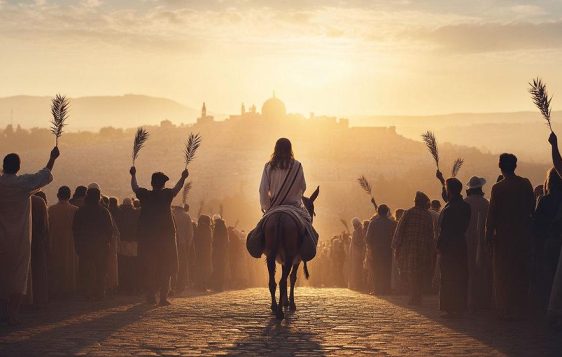
In Luke 19:28–40, Jesus had His own grand entrance.
Luke 18 and 19 have been building toward His arrival in Jerusalem, narrating the journey from the moment He told His disciples they were going there, through His visit to Jericho, and finally to Olivet, also known as the Mount of Olives.
It was on this hilltop that He set the stage for the moment His followers had been waiting for.
On the slopes of this ridge, near the villages of Bethany and Bethphage, He commanded two of His disciples to enter the village (Bethphage, according to Matthew 21) and look for a colt—a young donkey—that was tied up.
This would be a colt that had never been ridden. The disciples were to untie it and bring it to Jesus.
Anticipating that the owner would ask questions, Jesus told them to say, “The Lord has need of it.”
When the disciples entered the village, they found exactly what Jesus had said: a colt tied up.
As they began untying it, the owners asked what they were doing. Just as Jesus instructed, they told them that the Lord needed it. This apparently satisfied the owners, who allowed them to take the colt with no further discussion.
Matthew’s account also mentions a mother donkey who was brought along with the colt.
It might seem strange that Jesus felt the need to ride a donkey colt into Jerusalem when He had journeyed the whole distance so far on foot.
Had He simply grown so tired that He couldn’t walk the rest of the way?
No. As with everything He did, Jesus had a greater purpose in mind.
Zechariah 9:9 says:
“Rejoice greatly, O daughter Zion! Shout aloud, O daughter Jerusalem! See, your king comes to you; triumphant and victorious is he, humble and riding on a donkey, on a colt, the foal of a donkey.”
This passage prophesied the arrival of the coming ruler of God’s people, the King and Messiah they had been awaiting for centuries.
Just a few verses earlier in Luke, the people had been supposing that the arrival of God’s kingdom was imminent.
By fulfilling this prophecy, Jesus was intentionally delivering a message to all who saw Him.
The King had arrived, and His kingdom was being revealed.
As He rode down from Olivet toward Jerusalem, the multitudes gathered around Him, many of whom were His disciples, and began praising God.
Luke records their words in 19:38:
“Blessed is the king who comes in the name of the Lord! Peace in heaven, and glory in the highest heaven!”
Matthew 21:9 also records the crowd crying out, “Hosanna to the Son of David!”
The word “Hosanna” is a cry meaning “Save us!”
By calling Him King and Son of David and crying out for salvation, many in the crowd were acknowledging Him as the Messiah.
This served only to anger the Pharisees.
They were not standing at a distance but were actually mixed into the crowd. As Jesus grew close enough to them, they called out for Him to “order your disciples to stop” (Luke 19:39).
The Pharisees had long regarded Jesus as a false teacher, and hearing Him praised as their long-awaited Messiah must have been horrifying.
And if Jesus had indeed been only a prophet or healer, they would have had reason to object to such praise.
But Jesus was more than that.
And Jesus, who had carefully chosen the timing of His ministry and the revelation of His identity, was ready to make that clear.
“If these were silent,” He said in Luke 19:40, “the stones would shout out.”
His words echo a theme found in the Old Testament prophets: even creation itself bears witness to God’s glory and judgment.
Habakkuk 2:11 says, “The very stones will cry out from the wall, and the rafter will respond from the woodwork.”
The context of Habakkuk’s passage reveals a nation built on pride and wickedness, yet the prophet also declares that “the earth will be filled with the knowledge of the glory of the LORD” (Habakkuk 2:14).
In that moment, as Jesus approached Jerusalem, the people were witnessing His glory, but they understood it only in part.
They had seen Him as a miracle worker and a teacher. They acknowledged Him as the Son of David. They celebrated His arrival as King.
But the true depth of what that meant would not become clear until He had faced the darkest facets of humanity—all the sin, injustice, and death a fallen world could offer—and overcome them through the power of His resurrection.
His entry into Jerusalem marked a public announcement of His kingship and the arrival of God’s promised kingdom.
But the greatest glory was yet to come.
Copyright © 2026 Lifeword.org. All rights reserved. No part of this article may be reproduced or reprinted without permission in writing from Lifeword.org
- Addiction (44)
- Bible Devotionals (413)
- Blog (3223)
- Christian Living (1395)
- Church Life (171)
- Culture (332)
- Devotionals (411)
- Discipleship (354)
- Evangelism (255)
- Lifeword Info (3)
- Marriage and Family (219)
- Ministry (201)
- Problems of Life (687)
- Questions About Christianity (5)
- Salvation (278)
- Spiritual Growth (650)
- Spiritual Questions (4)