
Blog

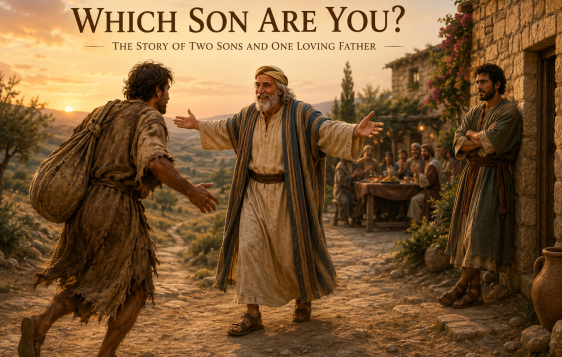
Which Son Are You?
What role do you fulfill in your family?
We all have our stereotypes. The oldest child is the dutiful one. The middle child is the rebel who gets forgotten. The youngest child is the spoiled baby. Sometimes those stereotypes hold true; in other families, they are wildly incorrect.
In my family, however, they’re fairly true. I’ve always been the rule-following eldest child. My two middle brothers took on different aspects of the middle child clichés, with one of them being more rebellious and the other more prone to quietly slipping into the background. He often joked growing up, “I’m always the last to know!”
My little sister, the baby of the family and the only girl, would admit that she got more spoiled and fewer punishments than the rest of us.
We have some old home video tapes from when I was a child, and we’ll watch them every once in a while. One in particular features me and my brother as toddlers. In the background, my parents were setting up the Christmas tree.
I, ever the observer and enforcer of rules, followed my baby brother around as he toddled to the coffee table and tried to grab the ornaments.
“Don’t touch those!” I snapped at him. “They are very special!”
In another, my mom taped one of our first days of homeschool. While I quietly worked on my activity sheet, my brother kept taking my markers, climbing on the table, and causing havoc. More than once, my mom had to turn off the camera. When it came back on, my brother would be sullenly sitting in his chair once more.
The Parable of Two Sons
In Luke 15:11-32, Jesus told the story of two brothers. This follows His parables about the lost sheep and the lost coin, and it is directly associated with them. However, He adds another element into this story that was absent from the other two: a negative response to the lost treasure being found.
We typically hear this story referred to as the Parable of the Prodigal Son, but I think that falls short of describing the full tale. I think, rather, that it should be the Parable of Two Sons, because the behavior of both sons is equally important to observe, as we can fall into the camp of both young men if we are not careful.
As the story begins, a young man comes to his father and requests his inheritance. This would have been an audacious request to make in the world Jesus lived in. An inheritance came when the parent died. For the young man to request his inheritance from the still-living father directly, he was effectively implying either that he wished his father was dead or that the father was as good as dead in his sight.
He didn’t matter anymore. His existence didn’t factor into the life the son wanted to live. All that mattered was what he could get out of his father so he could do what he wanted.
Instead of launching into a tirade or weeping at his son’s callous disregard, the father did as he was asked: he went ahead and divided the inheritance among his sons. He didn’t just give the younger son what was coming to him; he gave the older son his share as well.
But the younger son would have received the smaller portion. In those days, the eldest received a double share. He would have received two-thirds of the father’s possessions, with the younger brother getting the remaining third.
The Younger Son
That was enough for the young man. He hurried off just days later to a faraway country.
Very quickly, he spent everything he had been given.
Now, the father’s possessions were not just monetary. The inheritance would’ve included property, animals, and whatever other items of value the father possessed. The implication is that the younger son sold everything so that he could get more money.
And from there, he spent it all on “reckless living.”
He lived it up. Went to parties, gambled, and found the prettiest girls.
This is actually where the term “prodigal” comes from. We use it in association with something that is lost or has run away because of this story, but the word actually refers to someone who spends money recklessly and extravagantly.
No sooner was his money gone than a terrible famine struck the land.
The young man was obviously in need, so he hired himself out as a farmhand, feeding pigs. This would have been completely disgraceful in the Jewish culture, as pigs were among the most unclean animals in their religion.
He became so desperate that he even considered eating the pigs’ food. The carob pods pigs ate can’t be digested by humans. This means that the only reason he didn’t stoop to eating their food is because he couldn’t.
Even so, no one would give him anything.
The Son Returns Home
He eventually realized that his father’s servants were better off than he was. He came to a decision: he’d return home and submit himself to his father, asking to be made a servant.
He expressed humility and repentance, admitting his poor treatment of his father and not expecting to be welcomed back as part of the family. He didn’t treat his actions flippantly. He knew how terrible they were and was ready to admit it.
As he approached his father’s home, his father sprang into motion, running down the road toward him. Clearly, the father had been anxiously watching for the son’s return.
He met the young man where he was.
And when he did, he welcomed him with open arms. Not as a servant, but as a son.
He put a ring on his finger, a cloak on his shoulders, and ordered a feast to be prepared. Not just any feast: a fattened calf. This meant they had been feeding the calf intentionally, fattening it and saving it for a special occasion.
And in the father’s eyes, there was nothing more special than the return of his son.
The Older Son
But not everyone felt that way.
When the older brother returned from his work, he saw what was going on and asked why they were having a party. The answer—that his brother had returned home—filled him with anger.
He refused to go inside and greet his brother or join the festivities.
Finally, his father came out to check on him, and the older brother aired his grievances: he’d always been faithful to the father, but he never received a reward for his work.
This revealed the heart of his nature: he, too, was after what he could gain from his father.
He just wanted to get it the “right” way.
The father reminded him that everything he owned was his son’s. He’d already given out their inheritance. The older son could’ve thrown a party or been rewarded if he wanted to.
But he was so angry at his brother, he had missed that.
He was more focused on justifying himself, on looking like the good brother, than he was on actually having a relationship with his father and recognizing the bond they shared and the good gifts his father had given him.
Which Son Are We?
The father reminded the older son that the celebration was good. His brother had been lost and was found; he had been dead and was alive.
We do not find out if the older brother changed his attitude. We don’t get to see his repentance or a reconciliation with the brother.
And I think that was intentional on Jesus’s part, because it forces us—and the Pharisees He was speaking to—to wrestle with our own attitudes.
Which son are we?
Jesus told this story in the first place because the Pharisees had been complaining that He spent His time with sinners and tax collectors. They were the older brother, angry that Jesus was giving attention to the rebellious younger brother who didn’t deserve it.
They felt that because they followed the law, they deserved God’s blessings. But they didn’t realize that, like the older brother, their heart was in the wrong place and their focus was wrong. They thought that because they had been dutiful, they deserved whatever they expected the Father to give them.
The younger brother realized the error of his ways and ran back to the father in humility.
We all have to realize that as well.
God wants us to return to Him. But when we do, He doesn’t greet us as servants, but as children. He loves us—adores us—and embraces us with open arms.
Yet it’s easy, for some who have been believers for a substantial time, to scowl when they see people we don’t like coming to God and receiving the same treatment.
We should never be the judgmental older brother, asking God, “Why do they deserve to call themselves a Christian? I’m right here. I’m the one following the rules. Where’s my reward?”
The Father Took the First Step
There were two brothers.
Both started with the wrong attitude.
Yet the father longed for connection with both of them.
He came out to meet both of them where they were. The younger son on the road home, and the older son outside the house, where he was sulking.
But in both cases, it was the father who took the first step.
Likewise, God extended His hand to us by sending Jesus. He runs to us, reaches for us, and hopes we will step into His embrace.
Will you?
Copyright © 2026 Lifeword.org. All rights reserved. No part of this article may be reproduced or reprinted without permission in writing from Lifeword.org
- Addiction (44)
- Bible Devotionals (413)
- Blog (3200)
- Christian Living (1395)
- Church Life (171)
- Culture (332)
- Devotionals (411)
- Discipleship (354)
- Evangelism (255)
- Lifeword Info (3)
- Marriage and Family (219)
- Ministry (201)
- Problems of Life (687)
- Questions About Christianity (3)
- Salvation (278)
- Spiritual Growth (650)
- Spiritual Questions (2)