
Blog

Have you ever tried to get something that was limited edition or go somewhere with a limited number of openings?
Maybe you wanted to go to a football game or a concert. If you’re not online the moment tickets go on sale, there’s a good chance you won’t get in. People camp on those ticket sites, repeatedly hitting refresh until availability opens, and then they might buy 20, 30, or even 100 tickets. If they’re buying them to resell at a higher price, we call that scalping, and it’s illegal. But even without scalpers, gaining access to a highly anticipated event can be difficult.
Or maybe you’ve entered a giveaway or sweepstakes. The odds of winning are incredibly low. Out of thousands of entries from across the country, your name has to be the one that gets selected. When it comes down to it, yours is just another name in the bucket.
The year was 2005. Star Wars: Revenge of the Sith was about to hit theaters, and Cartoon Network was giving away an entire collection of Star Wars toys. I was a nine-year-old boy completely obsessed with Star Wars. I already owned a couple dozen action figures, but I didn’t have many from the new movie line, and I wanted them.
So I went to CartoonNetwork.com and entered the giveaway. I told my friends at school about it. Every day after school, I pulled up that same webpage, hoping my name would be announced as the winner.
The school year ended.
The movie came out.
I didn’t win.
Life goes on.
That’s how it is with exclusive opportunities. It’s hard to win. Hard to get in. And if you’re lucky enough to be on the inside, you’re one of the few while everyone else is left watching from the outside.
Jesus was on His way to Jerusalem in Luke 13:22–30, teaching in each town He passed through, when someone asked Him an important question:
“Lord, will only a few people be saved?”
With the context of the whole Bible, we understand this question to mean salvation from sin and death. I wonder if that’s exactly what the man had in mind, or if there was something more behind his question. Most Jews expected the Messiah to save them from Rome, not from sin, so perhaps he was thinking in political terms. Or perhaps he truly was asking about eternal salvation.
Either way, it was a valid question.
John 6:66 tells us that many of Jesus’ followers eventually turned away and stopped following Him. Perhaps this question arose as it became obvious that the truly committed disciples were fewer than the crowds who had gathered for miracles and entertainment. As people became bored, fearful, or offended, they simply went home.
Even more significantly, Jesus had repeatedly condemned the religious system of Israel. Time after time He warned the Pharisees that they, too, needed to repent. In the minds of most Jews, their heritage as descendants of Abraham guaranteed their place in God’s kingdom. But if even the Pharisees weren’t guaranteed entrance, what hope did everyone else have?
Jesus’ answer probably didn’t comfort the man.
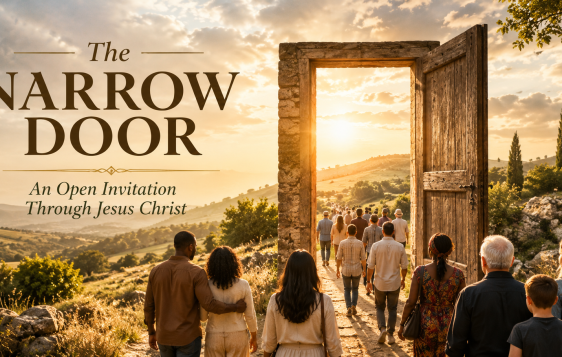
“Strive to enter through the narrow door. For many, I tell you, will seek to enter and will not be able.”
At first glance, it sounds exclusive—as though only a select few will be accepted. If the Pharisees aren’t on the guest list, who could possibly make it?
Jesus continued by describing people who would say, “We ate and drank in your presence,” and “You taught in our streets.” But simply being around Jesus was never enough. Proximity did not equal participation.
The word strive can easily be misunderstood. Jesus was not teaching salvation by works. The word carries the idea of struggling or contending. The real struggle was internal. His listeners had to wrestle with abandoning the belief that their ancestry guaranteed entrance into God’s kingdom. They had to lay aside national pride and trust the way Jesus was establishing—a way of faith rather than confidence in keeping the Law for righteousness.
Then Jesus uses a phrase we often associate with hell:
“In that place there will be weeping and gnashing of teeth.”
Certainly, Jesus taught about eternal judgment elsewhere. But in this immediate context, He was describing people who found themselves excluded from the kingdom that was already breaking into the world through His ministry. Throughout Scripture, gnashing of teeth frequently expresses anger and bitter resentment. They would weep because they had rejected the very kingdom they longed for, and they would grind their teeth in rage as they realized that Abraham, Isaac, Jacob, and the prophets had embraced the promises they themselves had refused by rejecting Jesus.
But we shouldn’t conclude that entrance into God’s kingdom is reserved for only a tiny handful.
Just a few verses later Jesus declares:
“People will come from east and west, and from north and south, and recline at table in the kingdom of God.”
The kingdom was never meant to remain confined to one nation. The invitation would extend to the entire world. The gospel would spread far beyond anything the Jewish people of that day imagined. While many believed God’s kingdom belonged almost exclusively to Israel, Jesus announced that people from every direction would gather at His table.
These verses are often used to produce fear.
“The way is narrow, so you’d better get on the right track or you’ll miss heaven.”
Certainly, there is only one entrance into God’s kingdom: faith in Jesus Christ. But this is not an exclusive guest list with a maximum occupancy. It is an open invitation extended to everyone willing to enter through the narrow door by trusting Christ.
Here is the wonderful news:
We don’t have to wait until heaven to know whether we belong to God’s kingdom.
If you have placed your faith in Jesus Christ, you are part of His kingdom right now. Your life of following Him is evidence of that reality. There is no need to live in constant fear, wondering whether you’ll make it through the narrow gate.
Jesus’ warning was directed toward people who assumed they already belonged because of their heritage or religious identity. Their problem wasn’t that the door was locked. Their problem was that they refused to enter through the only door God had provided. They treated Jesus as an interesting teacher rather than surrendering to Him as Lord and Savior.
They couldn’t claim entrance by saying, “I’m a child of Abraham.”
They could only enter by saying, “I am a blood-bought follower of Jesus.”
The same is true today.
The invitation is open.
The door is Christ.
All who place their faith in Him are welcomed into His kingdom.
Copyright © 2026 Lifeword.org. All rights reserved. No part of this article may be reproduced or reprinted without permission in writing from Lifeword.org