
Blog

Have you ever left something running, walked away, and come back to find it
overflowing and making a mess everywhere? We see this in cartoons and TV shows all the
time. Maybe it’s a bubble bath or a dishwasher filled with too much soap. Bubbles are
everywhere, covering the bathroom or kitchen floor. Maybe it’s just water—a plugged sink left
running that ends up soaking the whole counter and dripping onto the floor.
It could be a clogged toilet, which is always unpleasant to deal with. Usually, we catch
those before they spill out of the bowl, but I’m sure there have been incidents when someone
wasn’t so lucky.
Recently, my three-year-old wanted some juice. I told her I’d get her some, but she said,
“No. I get it.” She dragged her stool over to the kitchen counter. Opened the fridge. When I took
the juice out, she insisted that she wanted to do it, so I told her I was just getting it out for her. I
let her climb up on the stool, my wife got her a cup, and we let her pour her own juice. The
bottle was almost empty, so when she turned it upside down, most of it went in her cup. It did
overflow a little bit, though, and she said “Uh-oh!” But it was an easy mess to clean up and she
was proud of her own accomplishment.
Meanwhile, at work that very same week, I made a much bigger mess. I was filling a bin
of mustard from the carton it came in. The mustard was slow to pour out, so I tilted the carton up
just a little higher—and suddenly, the entire table was covered in mustard. A literal mountain of
it. I had to use three cloth towels, several paper towels, and a bucket to clean up the mess, and
even then, the table was stained yellow. As I was cleaning it, my manager walked back looking
for me and said, “Hey, I need you to—” He stopped, nodded his understanding of the situation,
and walked away.
When something expands, it can be hard to contain again. You can’t force helium back
into a canister once it’s been emptied into a balloon. You can’t return toothpaste to its tube once
it’s been squeezed out. And you cannot stop the expansion of the kingdom of God and put it
back in a box.
Luke 13:10 begins with Jesus teaching in a synagogue. The location is unclear; He
might have been in His usual headquarter city, Capernaum, or He might have been on the road
somewhere. Regardless, He had an opportunity to teach in the synagogue, and He took it. As
He was teaching, He noticed a woman who had been crippled for eighteen years. Her back was
hunched over, and she couldn’t stand straight. This is one of those instances where we get a bit
of medical detail in Luke that is not provided in other passages; as a physician, Luke was
interested in the ailments of those Jesus healed.
Unlike other recipients of Jesus’ healing, this woman did not ask Him to do it. She did
not come to Him hoping for restoration. It was Jesus who initiated the contact, and He did so
without asking her if she had faith. This was a wholly unprompted healing, an act of kindness
and compassion.
Of course, the ruler of the synagogue had something to say about this. This was not a
Pharisee; not the kind of person we’d think of when we hear the word “ruler.” Most likely, this
was the guy who was in charge of taking care of the building and determining who would read
Scripture; he was a manager, not a minister. In any case (maybe because he would have been
the one who chose Jesus to speak), he took issue with Jesus’ healing, because to him, it
seemed like work on the Sabbath day. He did not just criticize Jesus, but actually turned and
spoke to the crowd, telling them not to emulate Jesus’ example or to even seek healing. “There
are six days on which work ought to be done; come on those days and be cured and not on the
Sabbath day.” (13:14)
This filled Jesus with righteous anger. He called the man a hypocrite and asked if he
would untie his ox or donkey on the Sabbath so they could get water. If so, wasn’t the affliction
of a human woman more meaningful than an animal’s thirst? This response shamed those who
were speaking against Him, and brought glory to God. Seeing the positive response among His
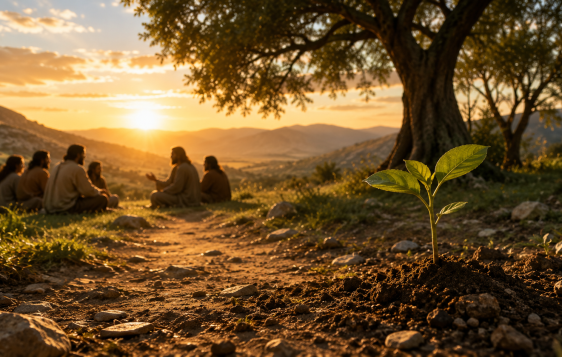
listeners, Jesus spoke about the nature of the kingdom of God: that it was ever-growing. Like a
seed becoming a tree or leaven in dough causing bread to rise, the kingdom is small and
subversive, but grows exponentially. Once that growth begins, it cannot be halted.
Sometimes, it doesn’t seem that way, does it? We look around, and the world seems full
of wickedness and hatred. Christianity seems like it’s weak and sickly, not growing and
powerful. From an America-centric viewpoint, that might be the case. Secularism and
selfishness seem to be winning the day. But around the world, the kingdom of God is
prospering. Underground churches are flourishing; thousands upon thousands are coming to
call Jesus “Lord.” Because the Gospel works best as something small that explodes into
amazing growth. Something that spills over from an original source. Not something that is forced
by a powerful organization or structured system, but that is carried out in small acts of kindness
and love, one person at a time.
It reminds me of a scene in the film version of J.R.R. Tolkien’s The Hobbit. Tolkien was a
member of the Catholic church, and though he denied the idea that allegorical representation of
a Christian message was present in his stories, it is apparent that his worldview worked its way
into his literature naturally. The filmmakers recognized this, and many of the messages within
the movies can be applied readily to the Christian faith.
In this particular scene, Gandalf—the wizard who organized the team of Dwarves who
was to defeat a dragon and take back their mountain home—was asked why he had chosen
Bilbo Baggins, a half-sized Hobbit who preferred books and a chair by the fireplace over going
on dangerous adventures, to be the team’s burglar. Gandalf responded:
“I don’t know. Saruman [Gandalf’s cynical mentor] believes that is only great power that
can hold evil in check. But that is not what I have found. I have found it is the small things.
Everyday deeds of ordinary folk that keep the darkness at bay. Simple acts of kindness and
love. Why Bilbo Baggins? Perhaps it is because I am afraid, and he gives me courage.”
Jesus was powerful. Not just powerful; all-powerful. Yet He used that power not to
establish an empire or assert dominance; He used it for simple acts of compassion. Healing.
Casting out demons. Calling sinners to a second chance. This is how He built the foundation of
His kingdom, and it is how we continue to build it. We don’t need to have a majority to make a
difference. We don’t have to be the most influential voice in the room to change the world.
What we need is to express God’s love in our daily lives. Do good. Be charitable. Speak
kindness, forgiveness, and hope into the lives of those around you. Show them the kingdom,
and in doing so provide a reason that following Jesus is the better way. This is how we can
make the greatest impact on the culture around us. It won’t come by forcing others to listen to
sermons or demanding compliance to our rules. It will come by showing God’s love and sharing
His truth as we show people we care about them.
That’s the good news. The kingdom is expanding. It will continue to expand. Slowly,
subversively, but it will. And it won’t happen all at once, but it is an unstoppable growth that will
one day span the globe.
Copyright © 2026 Lifeword.org. All rights reserved. No part of this article may be reproduced or reprinted without permission in writing from Lifeword.org
- Addiction (44)
- Bible Devotionals (413)
- Blog (3205)
- Christian Living (1395)
- Church Life (171)
- Culture (332)
- Devotionals (411)
- Discipleship (354)
- Evangelism (255)
- Lifeword Info (3)
- Marriage and Family (219)
- Ministry (201)
- Problems of Life (687)
- Questions About Christianity (3)
- Salvation (278)
- Spiritual Growth (650)
- Spiritual Questions (2)