
Blog

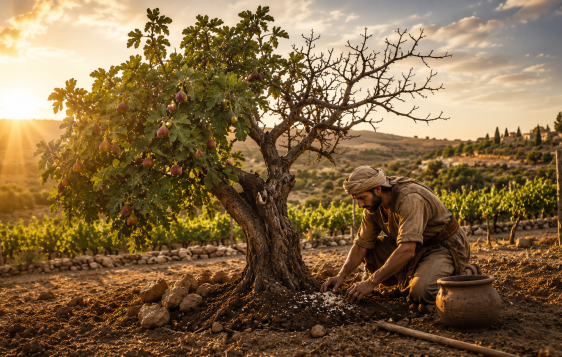
Some people are really good at caring for plants. They can plant flourishing gardens or decorate their houses with succulent plants. We call this **“having a green thumb.”** A person who can tend to plants and keep them alive and thriving just seems to be a bit more in touch with nature. **Others can follow all the right steps, do all the right things, and still manage to kill every plant they try to care for.**
My grandpa has a green thumb. In his backyard, he has lemon trees, orange trees, and grapefruit trees. **At one point, I believe he also had grapevines and perhaps tomato plants.** He grows great fruit. It takes some talent to do so, since he lives in the dry, arid valley near Phoenix, Arizona. I’m not sure how much he keeps them up anymore, now that he’s older and has more health problems, but for many years, they produced great fruit every year.
A tree’s fruit production is indicative of its health. A good, healthy tree will produce a lot of fruit. An unhealthy one will produce very little fruit, if any at all. And when it becomes unhealthy, it’s time to take stock of what to do with it. Do you leave it there? Try to get it to grow next season? Uproot it and plant a new one? A decision has to be made because there is no benefit to an unhealthy fruit tree.
There are multiple times in the Bible when people are compared to fruit trees. We are told to be fruitful, to produce fruit, and that we will be judged by the fruit we bear. Jesus talks about this in Luke 13:6–9. But first, let’s get the context that comes from the first five verses in this chapter.
Some people in the crowd told Jesus about some Galileans who had been brutalized by Pilate. The Roman governor had taken these people, who were probably rebels against the Roman government, killed them, and mixed their blood with animal sacrifices (Luke 13:1). Mixing human blood with sacrifices to God would have been the grossest form of blasphemy. Jesus used this story as an opportunity to ask a question: “Do you think that because these Galileans suffered in this way they were worse sinners than all other Galileans?” (Luke 13:2).
Back in His day, people presumed that great catastrophes and bad circumstances were caused by sin. If something bad happened to you, it was because you deserved it. You must have done something wrong to earn the punishment. Some might call that “karma.” Have you ever heard someone say that somebody else got what they deserved? “It’s bad karma.” That’s **kind of** how they thought back then, **also.** But Jesus said, “No, I tell you, but unless you repent you will all perish as they did” (Luke 13:3). Then He brought up a second catastrophe: a tower in Siloam had fallen and killed eighteen people. He reiterated His point that those killed in the fall had not been worse sinners than anyone else in Jerusalem. Again, He said that His listeners had to repent, or they would just as surely die.
As He often did, Jesus used this as a springboard into a parable. He spoke of a fig tree **that its owner found fruitless.** He came to the vineyard’s keeper and asked about it. For three years, he had waited for it to produce fruit. Nothing had come. He made a firm judgment: “Cut it down. It’s just wasting space.” But the keeper responded, “Give it one more year, and I’ll pay extra attention to this tree. Maybe next year, **it will bear fruit.** If not, you can cut it down.”
The point of the parable is that God doesn’t allow calamity to strike some people for their sins and let others walk free. He judges all people equally. He watches us for signs of fruit. Often, fig trees were a symbol of the people of Israel. When Jesus spoke this parable, He was talking about those who already identified themselves as God’s people. In other words, **they were not exempt from His examination.** He was watching them for signs that they were growing, too. Evidently, they had been showing little sign of productivity. But the merciful keeper represented Jesus, who in His grace chose to extend mercy and give more opportunities for growth and repentance.
This was not Jesus saying that good works or producing fruit were necessary for salvation. They do not earn us a place in God’s kingdom. But James 2:14–26 clearly teaches that faith without works is dead. The deeper reality taught by this passage is that true, saving faith always leads to the production of fruit. Genuine followers of Jesus will demonstrate their faith through their works. **The change He makes in our hearts, along with the guidance of the Holy Spirit, will naturally lead us to do the kinds of good works** that honor God and bear fruit.
But I also think it’s more than just doing things. Think about the Fruit of the Spirit. This fruit is evidence of the Holy Spirit’s work in our lives as well. If we do not exhibit these qualities, then we are not bearing fruit. Someone who doesn’t show the Fruit of the Spirit is like a fig tree that has not produced figs—lifeless. It is evidence that while there may be some resemblance of life, there is no power behind it. The Pharisees gave the illusion of life: worshiping in the temple, performing daily rituals, maintaining their cleanliness, and so on. But their hearts were far from God and set on repetitious religious practice rather than genuine obedience.
Seeing other people undergo tragedies and disasters while we prosper should not make us think that we must be right with God and they must be sinners. Rather, we should thank God for His mercy and take stock. Are we producing fruit? Do we represent Him well? Or are we like a lifeless fig tree that might look good enough to stay in the garden for three years but, in reality, cannot bear fruit?
Copyright © 2026 Lifeword.org. All rights reserved. No part of this article may be reproduced or reprinted without permission in writing from Lifeword.org
- Addiction (44)
- Bible Devotionals (413)
- Blog (3205)
- Christian Living (1395)
- Church Life (171)
- Culture (332)
- Devotionals (411)
- Discipleship (354)
- Evangelism (255)
- Lifeword Info (3)
- Marriage and Family (219)
- Ministry (201)
- Problems of Life (687)
- Questions About Christianity (3)
- Salvation (278)
- Spiritual Growth (650)
- Spiritual Questions (2)