
Blog

Every year in October, my church hosts an event called Harvest Day. It is a service with a special emphasis on inviting a guest. We encourage our members to bring a family member, friend, neighbor, or coworker to church. After the service, we have a meal catered by a couple in our church, with each member bringing a dessert. It’s one of my favorite services of the year.
There’s a tried-and-true stereotype that if there’s one thing Baptists love to do, it’s eat. I remember having so many potlucks at the church my dad pastored in Kansas when I was a teenager. On the first Sunday night of every month, we had a sing night, where we did nothing but sing songs instead of having a sermon, and at the end of the night, we had a potluck meal. In months with a fifth Sunday, we had a special morning service with a potluck immediately afterward, and once the potluck was over, we had an afternoon service instead of an evening service. So at least fifteen times a year, we had a church-wide meal, and there were often other occasions as well.
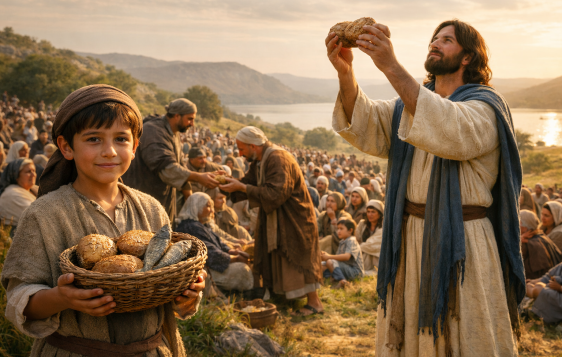
When you think of a potluck, you typically think of everyone bringing a dish. It’s not just for them; it’s a dish to share. And while this wasn’t the intention of a young man in Luke 9:10–17, that is essentially what he did—and it led to what could be considered the first “potluck” in church history. It’s one of the most famous miracles Jesus performed, recorded in all four Gospels: the feeding of the five thousand.
The disciples returned from the mission Jesus sent them on with a report of their success. After this, Jesus took them to Bethsaida. The verbiage of the passage (they “withdrew” or “slipped away quietly” to Bethsaida, depending on the translation) indicates that they were likely seeking a quiet retreat. They had been busy following Jesus’ instructions, and He was leading them into a time of rest. This is important for all of us—we must take time to rest when we are serving God. Our bodies, minds, and souls were not intended for constant, unending labor, even when that labor is meant to bring honor to God. A time of rest is important, and it should be taken regularly.
Unfortunately, word spread quickly, and the crowds learned of His presence at Bethsaida. They followed Him there. Even though He had intended this to be a restful time, He did not turn the crowds away when they arrived. He welcomed them and used the opportunity to heal and teach. As the day went on, the crowd showed no sign of diminishing, so the disciples urged Jesus to send the people back into town to find food and lodging. They were outside the town with nowhere to eat or spend the night. However, Jesus was fully engaged in ministering to them and did not want the people to leave. He told the disciples to feed the crowd. The disciples replied that all they had (which we know from John 6:1–15 came from a young boy in the crowd) was five loaves of bread and two fish—hardly enough to feed such a large group. Mark 6:30–44 notes that even two hundred denarii—about eight months’ wages—would not have been enough to buy sufficient food.
Jesus told them to have the people sit in groups of fifty. Then He took the food and blessed it. He instructed the disciples to distribute it. As they did, the food multiplied, and it did not run out. Everyone ate and was satisfied. When they finished, there were twelve baskets full of leftovers. Jesus fed five thousand men (plus women and children, possibly bringing the total to around twenty thousand people) from the lunch packed by a young boy.
God provides. In the previous verses of Luke 9, Jesus had sent out the disciples with no belongings or provisions because He wanted them to learn to rely on God’s provision. Here we see that sometimes God’s provision comes through the willing surrender of His people. A boy gave Him five loaves of bread and two fish, and He turned it into dinner for thousands. What might God do if we simply give Him our “yes” and trust Him with the rest? Maybe you don’t think you’re good enough. Maybe you feel like nothing you have to offer is significant. But nothing is insignificant when we place it in God’s hands. He can take our small offering and multiply it into something far greater than we could imagine.
This is a call to action. Not to take on the full responsibility ourselves—because the boy could not have fed the crowd with his lunch in his own strength—but to trust Jesus with what we have. When we offer Him what little we possess, He can accomplish something far beyond our ability. Likewise, if we put forth our best effort in serving God but never trust Him with the results, we will exhaust ourselves striving for outcomes we cannot control. But when we let Him handle the results, the pressure lifts. We can simply say, “God, I know You want to use me, so here I am. Show me how and where, and I’ll do my best. Whatever comes from that is up to You.” We cannot manufacture success, but we can give God our obedience and trust Him with the multiplication.
Copyright © 2025 Lifeword.org. All rights reserved. No part of this article may be reproduced or reprinted without permission in writing from Lifeword.org
- Addiction (44)
- Bible Devotionals (413)
- Blog (3205)
- Christian Living (1395)
- Church Life (171)
- Culture (332)
- Devotionals (411)
- Discipleship (354)
- Evangelism (255)
- Lifeword Info (3)
- Marriage and Family (219)
- Ministry (201)
- Problems of Life (687)
- Questions About Christianity (3)
- Salvation (278)
- Spiritual Growth (650)
- Spiritual Questions (2)