
Blog

There are certain miracles in the Bible that can seem like ancient and impossible myths—events we do not commonly see in the modern world. Miracles such as Jesus healing sick people are not so hard to believe; we see people recover every day through medicine, surgery, or treatment. Some of us may have even known people who were impossibly sick yet experienced a recovery that felt nothing short of miraculous, even without a doctor’s help.
When my family first moved to Arkansas, there was a man in our church who was diagnosed with cancer—either in his pancreas or his liver. Either way, it was extremely dangerous due to its location and how advanced it was. When the church prayed for him and he returned to the doctor, the cancer was gone. There was no explanation and no treatment—he had simply been healed. Sadly, his cancer returned years later, and he eventually passed away. However, for eleven years, he lived completely cancer-free without explanation. While we may not hear stories like this every day, we hear them often enough that they feel believable and grounded in reality.
Other miracles, however, are far more difficult to understand. For example, the biblical occurrence of speaking in tongues—where the preacher spoke in one language, yet everyone heard and understood it in their own—can be hard to comprehend. Another miracle that is difficult for many people to grasp, especially American Christians, is the exorcism of demons. In some parts of the world, this is still a regular occurrence. I have heard multiple stories from missionaries in Africa who have witnessed demons being cast out. In the United States, however, this seems far less common. I don’t know whether demon possession is less frequent here, or whether we as Christians have failed to recognize it—or respond to it.
Either way, this is not a miracle we see often, so it feels supernatural and even fantastical to us. Yet it is important to realize that these possessions were very real. Some cases, from our modern perspective, might be diagnosed as schizophrenia, dissociative identity disorder, or another mental illness. I am not opposed to science; these conditions are real and often require medical and psychological treatment. However, I also believe it is possible that some afflictions are spiritual in nature rather than purely physical or mental.
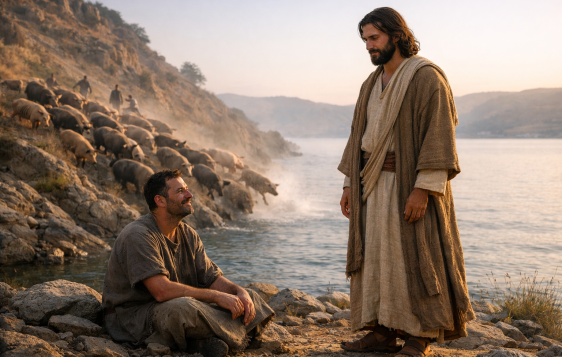
Right after Jesus calmed the storm on the Sea of Galilee, He and His disciples arrived on the opposite shore, in a region called the Gerasenes, where they were immediately met by a man from the city. Matthew 8:28 tells us there were two men, while Mark 5:2 and Luke 8:26–39 mention only one. Some view this as a contradiction, but it need not be. It is likely that one man was more dominant—the one who spoke—while the other remained silent.
Luke describes this man as naked, living among tombs, and in severe physical distress. Mark adds that he often cut himself with stones. By living among the tombs, he was considered ceremonially unclean according to Jewish law, which forbade contact with the dead. He had been chained and restrained repeatedly, yet he broke free every time. The shackles would have bound his feet, and the restraints would have pinned his arms to his sides. This was not natural strength—nothing could hold him, because his power was not from Earth.
When the man saw Jesus, he cried out, “What have You to do with me, Jesus, Son of the Most High God? I beg You, do not torment me!” The demons immediately recognized Jesus as the Son of God and knew His authority far exceeded theirs. When Jesus asked their name, they replied, “Legion,” because there were many. A Roman legion could contain up to six thousand soldiers, suggesting the extent of this man’s suffering.
The demons begged Jesus not to send them into the abyss—the place where demons are bound. Second Peter 2:4 refers to this place as Tartarus, a term borrowed from Greek mythology. While Hades referred to the realm of the dead, Tartarus was believed to be the place where the gods imprisoned the Titans. Jewish tradition adopted this term to describe the prison of fallen angels. Jesus granted the demons’ request, allowing them to enter a nearby herd of pigs—about two thousand, according to Mark 5:13. The pigs immediately rushed down a steep bank and drowned in the sea.
The herdsmen ran to the city and told everyone what had happened. When the people arrived, they found the man clothed, in his right mind, and sitting at Jesus’ feet. Instead of rejoicing, they were afraid—and likely angry over the loss of their livestock. They asked Jesus to leave, and He did. But the man—both men, having been healed—went throughout the region proclaiming what God had done for him. He even spread the news throughout the Decapolis, ten Gentile cities in the area.
Thinking about demons and the occult is uncomfortable, but the main point of this passage should bring us peace. We do not need to fear demons, because Jesus has absolute authority over them. He is greater than demons. He is greater than Satan. Jesus and Satan are not equal opposites locked in battle. Jesus possesses infinite power; Satan has none apart from what God allows. By casting out these demons, Jesus demonstrated His authority and once again confirmed that He is the Messiah.
We have a Savior who reigns over all things—both physical and spiritual. Because of that, we truly have nothing to fear.
Copyright © 2025 Lifeword.org. All rights reserved. No part of this article may be reproduced or reprinted without permission in writing from Lifeword.org