
Blog

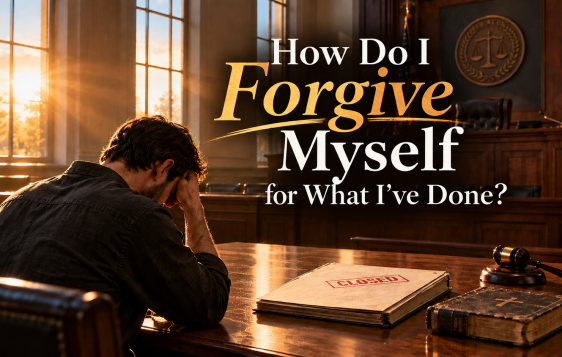
Someone who loves you has probably said it by now. Over coffee, in a text, maybe just with a look: “You need to forgive yourself.” They mean well. You’ve heard it so many times you could say it back to them in your sleep. And still nothing changes, because knowing you’re supposed to forgive yourself and knowing how are two entirely different problems — and very few who say the sentence ever tell you how.
Here’s a detail from outside church language that might land differently. In American law there’s a principle called double jeopardy: once you’ve been tried for a crime and the case is closed, the state cannot try you again for the same offense. Not if new evidence turns up. Not if a prosecutor has second thoughts years later. Not ever. The protection is written into the Constitution because a society decided a person cannot be made to answer for the same charge twice.
You don’t extend yourself the same courtesy. You reopen the file every few weeks — same night, same decision, same words you can’t take back — and retry the case from the beginning, as if a new verdict might finally stick.
Is forgiving yourself something the Bible actually asks of you to do? Not exactly — and said plainly, that’s a relief, not a disappointment. Forgiveness is God’s to give, not something you manufacture a second time on your own. He gives it to everyone who has trusted Jesus — God’s own Son, who died on the cross carrying the actual charge against them and rose to life three days later to prove the debt was paid (1 John 1:9). If you haven’t yet put your trust in Him, that’s the real starting point; what follows isn’t a status you already have, it’s an invitation. For everyone who has already come to Christ, the command was never “acquit yourself again.” It was “confess it, and receive the verdict I’ve already handed down.”
Why This Feels Impossible
Part of the problem is that God’s forgiveness feels abstract in a way your sin never does. “God forgives sinners” sounds like a general policy, the kind of thing that’s obviously true for other people. But you know exactly what you did, exactly who it cost, exactly what it says about you when you’re honest about it — and specific things are harder to believe get covered by general promises.
So a second court convenes. Nobody swore you in. God never authorized it. It runs anyway, on a loop, re-litigating a case that was already closed the moment you brought it to Him. And here’s what makes it so hard to shut down: it doesn’t feel like unbelief from the inside. It feels like integrity — like you’re the one person still taking your sin seriously enough not to let it go cheaply.
But there’s a difference between taking sin seriously and taking your own verdict more seriously than God’s. Only one of those is humility.
“If we confess our sins, he is faithful and just to forgive us our sins and to cleanse us from all unrighteousness.”
1 John 1:9, ESV
Read what that verse is actually claiming. It doesn’t say God forgives once your feelings catch up to the facts. It says He is faithful — He keeps His word whether or not you feel He has — and just, meaning the debt was genuinely paid, not quietly written off because He decided not to notice. The moment you confessed, the file was closed. Not softened. Closed.
That closing is what Romans 8:1 is describing when it says, “there is therefore now no condemnation for those who are in Christ Jesus” (ESV). Notice the qualifier — for those who are in Christ Jesus. This isn’t a blanket amnesty handed to everyone by default. It’s the verdict for people who have trusted Jesus specifically: that He is God’s Son, that He died on the cross carrying their actual guilt, and that He rose bodily three days later, proving the payment was accepted. Being “in Christ” means you’ve staked your case on that — not on being raised in church, not on believing God exists in general, but on trusting Jesus Himself as Lord and asking Him to be the one who settles it. It’s a legal term, not a feeling — a statement about your actual status before God, settled at the cross rather than by your behavior since. If you belong to Christ, no future reopening of the file can produce a worse verdict than the one that’s already been overturned. And if you’ve never made that trust explicit, today is as good a day as any to stop carrying a case that was never yours to close, and hand it to the One who already paid for it.
Why “Forgive Myself” Isn’t Quite the Right Question
“How do I forgive myself” isn’t quite the right question, and that’s worth saying directly instead of easing into it. Forgiveness requires someone with standing to release a debt they’re personally owed. You don’t hold that standing over your own sin — God does, and He’s already exercised it, in full, through Christ. So the task in front of you was never to generate a second, private act of forgiveness running parallel to His. It’s to stop retrying a case someone else already has full jurisdiction over, and to start living as if the ruling stands.
That’s not license to shrug off what you did. Genuine repentance doesn’t erase the earthly weight of a choice — a relationship you damaged may take years to rebuild; a consequence you set in motion may still be unfolding. Holding both of those at once is not a contradiction: the consequences can remain real while the question of where you stand with God is no longer open for appeal.
How Do I Stop Feeling Guilty After I’ve Been Forgiven?
Guilt doesn’t disappear the moment you understand the theology, and expecting it to is its own kind of setup for discouragement. Three things help the feeling catch up to the fact:
- Name the specific sin, out loud or on paper, every time it resurfaces — vague guilt is slippery and hard to answer; a named sin can be met with a specific verdict.
- Answer it with Scripture’s actual words, not your own reassurance. “There is therefore now no condemnation” carries weight your own self-talk doesn’t, because it isn’t yours — it’s the court’s ruling, not the defendant’s opinion.
- Let repetition do the work speed can’t. The old accusation had years to become familiar. The new verdict needs practice too. Bring the same memory back to the same two verses as many times as it takes.
A Closed File
Double jeopardy exists because a society decided that reopening a settled case isn’t justice — it’s cruelty dressed up as diligence. God settled your case at a cost you didn’t pay — the cost His own Son paid on a cross, three days before He walked out of a grave to prove it was enough. The next time you catch yourself pulling the file back out, you don’t need a new argument for why you’re forgiven. You already have the ruling. Read it again — Romans 8:1, out loud if you have to — and let it be the last word this time, not just one more thing you know but haven’t yet believed.
- Addiction (44)
- Bible Devotionals (413)
- Blog (3191)
- Christian Living (1395)
- Church Life (171)
- Culture (332)
- Devotionals (411)
- Discipleship (354)
- Evangelism (255)
- Lifeword Info (3)
- Marriage and Family (219)
- Ministry (201)
- Problems of Life (686)
- Questions About Christianity (1)
- Salvation (278)
- Spiritual Growth (650)
- Spiritual Questions (1)